
- Strong performance at Harsco Environmental and Rail, with each exceeding expectations in the quarter
- Strategic decision made to exit two European Harsco Rail ETO contracts, eliminating future execution risk, uncertainty, and cash outflows related to performance of these contracts; contract exits anticipated to conclude company’s exposure to its legacy ETO contract risks (see separate news release)
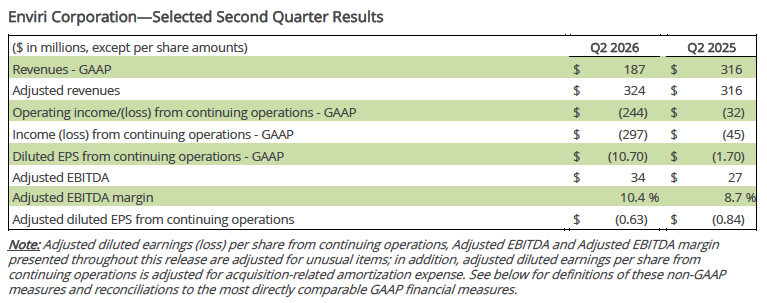
- Second quarter revenues from Continuing Operations totaled $187 million as reported and $324 million excluding the effects of ETO contract exit adjustments, an increase of 2 percent over the prior year; historical Clean Earth results now reported as Discontinued Operations
- Second quarter GAAP consolidated loss from continuing operations of $297 million, including charges for exiting the Harsco Rail ETO contracts as well as transaction-related unusual items resulting from the sale of Clean Earth and spin-off
- Adjusted EBITDA in Q2 totaled $34 million
- Second quarter GAAP diluted loss per share from continuing operations of $10.70 and adjusted diluted loss per share of $0.63
- Credit Agreement net leverage ratio now at 1.9x based on new capital structure
- 2026 Adjusted EBITDA outlook reaffirmed for Harsco Environmental and Harsco Rail
PHILADELPHIA (Aug. 11, 2026) – Enviri Corporation (NYSE: NVRI) (the “Company”) today reported second quarter 2026 results. On a GAAP basis, the second quarter of 2026 diluted loss per share from continuing operations was $10.70, including expenses related to the sale of Clean Earth and spin-off of Harsco Environmental and Harsco Rail, adjustments related to the termination of certain Harsco Rail contracts, and restructuring costs. Adjusted diluted loss per share from continuing operations in the second quarter of 2026 was $0.63. These figures compare with a second quarter 2025 GAAP diluted loss per share from continuing operations of $1.70, which included contract adjustments in Harsco Rail, an asset impairment and site exit costs in Harsco Environmental, and strategic expenses, and an adjusted diluted loss per share from continuing operations of $0.84.
The GAAP consolidated loss from continuing operations for the second quarter of 2026 was $297 million, while Adjusted EBITDA excluding unusual items totaled $34 million in the quarter.
“During the second quarter, our team executed well, with Harsco Environmental and Rail each delivering results above the high end of our guidance ranges while end-markets have remained subdued,” said Enviri President and CEO Russell Hochman.
“In addition, we took meaningful action to advance our strategic priorities that improve our financial profile and earnings potential while strengthening Enviri’s position as a leader in our markets. These actions include the strategic decision to exit two European Rail ETO contracts, removing a source of business uncertainty and financial volatility, including cash flows related to performance under these contracts. We also concluded the initial stage of our comprehensive business review, aimed at reducing our business complexity and driving operational excellence, and we have recently begun implementing broad restructuring actions across the Company. Lastly, we are reaffirming our 2026 outlook and will continue to prioritize initiatives that will drive sustainable value creation for shareholders.”
Consolidated Second Quarter Operating Results
Consolidated revenues from continuing operations were $187 million. Harsco Environmental realized an increase in revenues compared with the second quarter of 2025, while revenues for Harsco Rail were essentially unchanged year-on-year when excluding the contract exit impacts on revenues.
The Company’s GAAP consolidated loss from continuing operations was $297 million for the second quarter of 2026, compared with a GAAP consolidated loss of $45 million in the same quarter of 2025. Meanwhile, Adjusted EBITDA totaled $34 million in the second quarter of 2026 versus $27 million in the second quarter of the prior year. The increase in adjusted earnings is attributable to Harsco Environmental. Note that these results now exclude Clean Earth (reported as Discontinued Operations) and reflect that central costs previously allocated to Clean Earth ($1.9 million per quarter) are now included in the Corporate segment.
Second Quarter Business Review
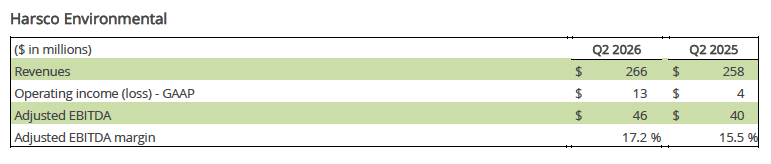
Harsco Environmental revenues totaled $266 million in the second quarter of 2026, an increase of 3% compared with the prior-year quarter. This revenue increase is attributable to higher volumes (services and ecoproducts) and higher services pricing. The segment’s GAAP operating income was $13 million, and Adjusted EBITDA totaled $46 million in the second quarter of 2026. These figures compare with GAAP operating income of $4 million and Adjusted EBITDA of $40 million in the prior-year period. The year-on-year change in adjusted earnings reflects the above-mentioned factors as well as internal improvement actions. As a result, Harsco Environmental’s Adjusted EBITDA margin increased to 17.2% in the second quarter of 2026 versus 15.5% in the comparable quarter of 2025.
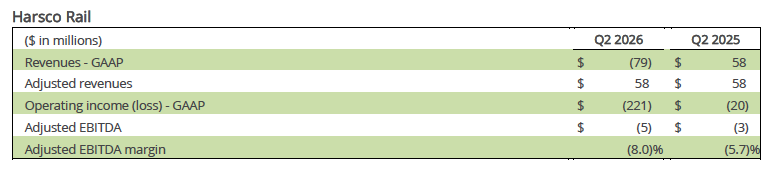
Harsco Rail revenues in the second quarter of 2026 totaled $(79) million. Excluding the adjustments resulting from the contract exits, revenues were $58 million, or unchanged year-over-year, as higher aftermarket volumes were offset by lower equipment and contracted services revenues. The segment’s GAAP operating loss was $221 million, and Adjusted EBITDA loss was $5 million in the second quarter of 2026. These figures compare with a GAAP operating loss of $20 million and an Adjusted EBITDA loss of $3 million in the prior-year period. The year-on-year change in adjusted earnings is attributable to the above factors as well as a change in business mix.
Cash Flow
Net cash used by operating activities was $297 million in the second quarter of 2026, compared with net cash provided by operating activities of $22 million in the prior-year period. Adjusted free cash flow was $(9) million in the second quarter of 2026, compared with $(39) million in the prior-year period (excluding Clean Earth and any transaction-related expenditures, which include the repayment of the Company’s accounts receivable securitization facility). The change in adjusted free cash flow compared with the prior-year quarter is attributable to higher cash earnings (adjusted for unusual items), working capital improvements, and lower net capital expenditures in Harsco Environmental and Rail.
2026 Outlook
The Company is reaffirming its 2026 Adjusted EBITDA guidance for Harsco Environmental and Harsco Rail, with key business drivers as follows:
Harsco Environmental Adjusted EBITDA of $170 million to $180 million, which is modestly above prior-year results at the mid-point of the range. Higher services and products demand, along with new sites and improvement initiatives, are expected to be offset by site exits and certain 2025 items that are not anticipated to repeat in 2026 (such as the recovery of certain sales tax expenses in Brazil).
Harsco Rail Adjusted EBITDA of $(26) million to $(19) million, which is below 2025 as a result of lower standard equipment and contracted services demand and related manufacturing inefficiencies, partially offset by cost-out activities and benefits.
Conference Call
The Company will hold a conference call today at 9.00 a.m. Eastern Time to discuss its results and respond to questions from the investment community. Those who wish to listen to the conference call webcast should visit investors.enviri.com, or by dialing (844) 539-1331 or (412) 652-1264 for international callers. Please ask to join the Enviri Corporation call. Listeners are advised to dial in approximately ten minutes prior to the call. If you are unable to listen to the live call, the webcast will be archived on the Company’s website.
Forward-Looking Statements
The nature of the Company’s business, together with the number of countries in which it operates, subject it to changing economic, competitive, regulatory and technological conditions, risks and uncertainties. In accordance with the “safe harbor” provisions of Section 27A of the Securities Act of 1933 and Section 21E of the Securities Exchange Act of 1934, the Company provides the following cautionary remarks regarding important factors that, among others, could cause future results to differ materially from the results contemplated by forward-looking statements, including the expectations and assumptions expressed or implied herein. Forward-looking statements contained herein could include, among other things, statements regarding the expected timing, completion and effects of the transactions contemplated by the Merger Agreement and the Separation Agreement, including the sale of Clean Earth and the spin-off of New Enviri; statements about management’s confidence in and strategies for performance; expectations for new and existing products, technologies and opportunities; and expectations regarding growth, sales, cash flows, and earnings, including those under “2026 Outlook”. Forward-looking statements can be identified by the use of such terms as “may,” “could,” “expect,” “anticipate,” “intend,” “believe,” “likely,” “estimate,” “outlook,” “plan,” “contemplate,” “project,” “target” or other comparable terms.
Factors that could cause actual results to differ, perhaps materially, from those implied by forward-looking statements include, but are not limited to: (1) the possibility that the Merger and Separation may not ultimately achieve the expected benefits; (2) the Company’s ability to effectively implement its business strategy and improvement initiatives and realize the expected benefits therefrom; (3) the Company’s ability to successfully enter into new contracts and complete new acquisitions, divestitures, or strategic ventures in the time-frame contemplated or at all; (4) the Company’s inability to comply with applicable environmental and safety laws and regulations; (5) the Company’s inability to obtain, renew, or maintain compliance with its operating permits or license agreements; (6) various economic, business, and regulatory risks associated with the industries in which the Company operates; (7) the seasonal nature of the Company’s business; (8) risks caused by customer concentration, fixed-price and long-term customer contracts, especially those related to complex engineered equipment and the competitive nature of the industries in which the Company operates; (9) the outcome of any disputes with customers, contractors and subcontractors; (10) the financial condition of the Company’s customers, including the ability of customers (especially those that may be highly leveraged or have inadequate liquidity) to maintain their credit availability; (11) higher than expected claims under the Company’s insurance policies, or losses that are uninsurable or that exceed existing insurance coverage; (12) market and competitive changes, including pricing pressures, market demand and acceptance for new products, services and technologies; changes in currency exchange rates, interest rates, commodity and fuel costs and capital costs; (13) the Company’s ability to negotiate, complete, and integrate strategic transactions and joint ventures with strategic partners; (14) the Company’s ability to attract and effectively retain key management and employees, including due to unanticipated changes to demand for the Company’s services, disruptions associated with labor disputes, and increased operating costs associated with union organizations; (15) the Company’s inability or failure to protect its intellectual property rights from infringement in one or more of the many countries in which the Company operates; (16) failure to effectively prevent, detect or recover from breaches in the Company’s cybersecurity infrastructure; (17) changes in the worldwide business environment in which the Company operates, including changes in general economic and industry conditions and cyclical slowdowns impacting the steel and aluminum industries; (18) fluctuations in exchange rates between the U.S. dollar and other currencies in which the Company conducts business; (19) unforeseen business disruptions in one or more of the many countries in which the Company operates due to changes in economic conditions, changes in governmental laws and regulations, including environmental, occupational health and safety, tax and import tariff standards and amounts; political instability, civil disobedience, armed hostilities, public health issues or other calamities; (20) liability for and implementation of environmental remediation matters; (21) product liability and warranty claims associated with the Company’s operations; (22) the Company’s ability to comply with financial covenants and obligations to financial counterparties; (23) the Company’s outstanding indebtedness and exposure to derivative financial instruments that may be impacted by, among other factors, changes in interest rates; (24) tax liabilities and changes in tax laws; (25) changes in the performance of equity and bond markets that could affect, among other things, the valuation of the assets in the Company’s pension plans and the accounting for pension assets, liabilities and expenses; (26) risk and uncertainty associated with intangible assets; and (27) the other risk factors listed from time to time in the Company’s SEC reports. A further discussion of these, along with other potential risk factors, can be found under the heading, “Risk Factors,” of the Company’s Information Statement, dated May 8, 2026, and attached as Exhibit 99.1 to the Company’s Current Report on Form 8-K furnished to the SEC on May 11, 2026. The Company cautions that these factors may not be exhaustive and that many of these factors are beyond the Company’s ability to control or predict. Accordingly, forward-looking statements should not be relied upon as a prediction of actual results. The Company undertakes no duty to update forward-looking statements except as may be required by law.
Non-GAAP Measures
Measurements of financial performance not calculated in accordance with GAAP should be considered as supplements to, and not substitutes for, performance measurements calculated or derived in accordance with GAAP. Any such measures are not necessarily comparable to other similarly-titled measurements employed by other companies. The most comparable GAAP measures are included within the definitions below and reconciliations of these non-GAAP measures to the most directly comparable GAAP financial measures are included at the end of this press release.
Adjusted diluted earnings (loss) per share from continuing operations: Adjusted diluted earnings (loss) per share from continuing operations is a non-GAAP financial measure and consists of diluted earnings (loss) per share from continuing operations adjusted for unusual items and acquisition-related intangible asset amortization expense. It is important to note that such intangible assets contribute to revenue generation and that intangible asset amortization related to past acquisitions will recur in future periods until such intangible assets have been fully amortized. The Company’s management believes Adjusted diluted earnings (loss) per share from continuing operations is useful to investors because it provides an overall understanding of the Company’s historical and future prospects. Exclusion of unusual items permits evaluation and comparison of results for the Company’s core business operations, and it is on this basis that management internally assesses the Company’s performance. Exclusion of acquisition-related intangible asset amortization expense, the amount of which can vary by the timing, size, and nature of the Company’s acquisitions, facilitates more consistent internal comparisons of operating results over time between the Company’s newly acquired and long-held businesses, and comparisons with both acquisitive and non-acquisitive peer companies.
Adjusted EBITDA: Adjusted EBITDA is a non-GAAP financial measure and consists of income (loss) from continuing operations adjusted to add back income tax expense; equity income of unconsolidated entities, net; net interest expense; defined benefit pension income (expense); facility fees and debt-related income (expense); stock-based compensation expense; and depreciation and amortization (excluding amortization of deferred financing costs); and excludes unusual items. Segment Adjusted EBITDA consists of operating income from continuing operations adjusted to exclude unusual items and add back depreciation and amortization (excluding amortization of deferred financing costs). The sum of the Segments’ Adjusted EBITDA and Corporate Adjusted EBITDA (which is adjusted for all stock-based compensation expense) equals consolidated Adjusted EBITDA. The Company‘s management believes Adjusted EBITDA is meaningful to investors because management reviews Adjusted EBITDA in assessing and evaluating performance.
Adjusted free cash flow: Adjusted free cash flow is a non-GAAP financial measure and consists of net cash provided (used) by operating activities less capital expenditures and expenditures for intangible assets; and plus capital expenditures for strategic ventures, total proceeds from sales of assets and certain transaction-related / debt-refinancing expenditures. Adjusted free cash flow also excludes the impact of the Clean Earth business. The Company’s management believes that Adjusted free cash flow is important to management and useful to investors as a supplemental measure as it indicates the cash flow available for working capital needs, repay debt obligations, invest in future growth through new business development activities, conduct strategic acquisitions or other uses of cash. It is important to note that Adjusted free cash flow does not represent the total residual cash flow available for discretionary expenditures since other non-discretionary expenditures, such as mandatory debt service requirements and settlements of foreign currency forward exchange contracts, are not deducted from this measure. This presentation provides a basis for comparison of ongoing operations and prospects.
# # #
About Enviri
Enviri is a global market leader providing environmental and operational solutions to the metal and rail industries. Based in Philadelphia, Pennsylvania, and operating in more than 30 countries, the company leverages over 170 years of industrial expertise to help customers improve operational performance, recover value from byproducts, enhance sustainability, and maintain critical infrastructure. Enviri’s divisions, Harsco Environmental and Harsco Rail, combine deep operational capabilities with innovative technologies and global scale to deliver long-term value for customers, communities, and shareholders. Learn more at enviri.com.